One of the first questions every new webcaster asks is simple:
“Can I legally play commercial music on my streaming radio station?”
The answer is yes—but only if you secure the appropriate licenses.
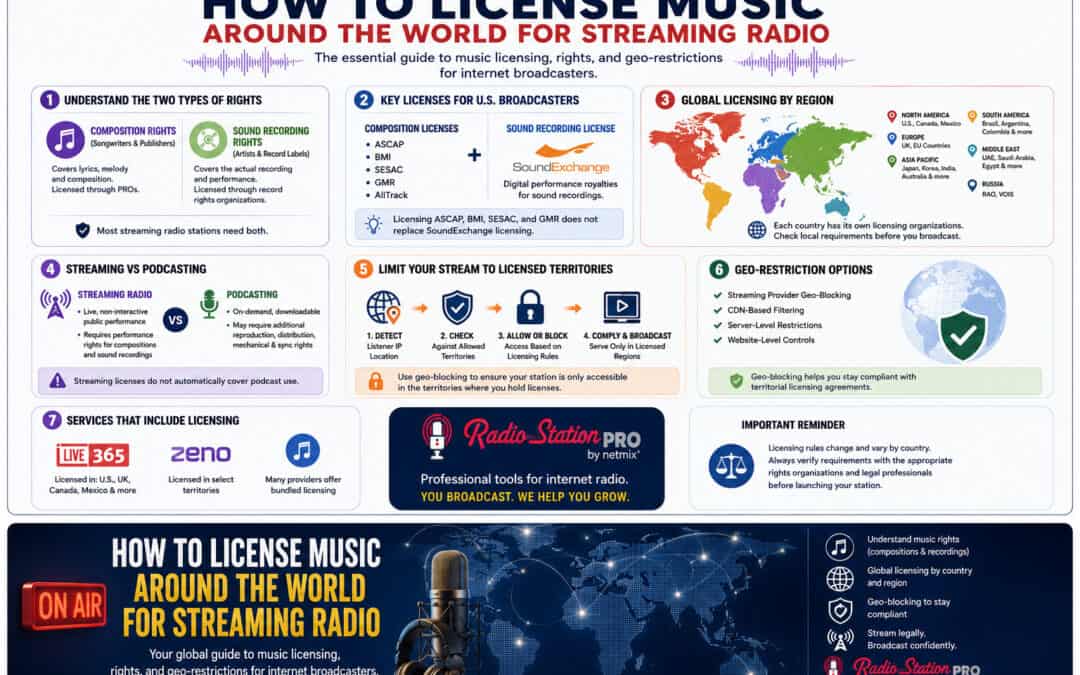
Music licensing is often the biggest obstacle facing new internet broadcasters. Unfortunately, there is no single global license that covers every country, every song, and every type of audio distribution. Licensing requirements vary by territory and differ significantly between live radio streaming, on-demand streaming, podcasting, and downloadable content.
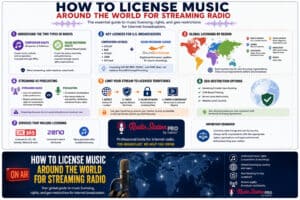
This guide explains how music licensing works for internet radio stations worldwide, helps broadcasters understand the key differences between streaming and podcasting, and outlines how to limit your stream to licensed territories when required.
- Understanding Music Rights
- Music Licensing in the United States
- ASCAP
- BMI
- SESAC
- What About GMR?
- The Simplest Explanation
- Important Note for Internet Radio Broadcasters in the United States
- Music Licensing in Canada
- Music Licensing in the United Kingdom
- Music Licensing Across the European Union
- Australia and New Zealand
- Asia-Pacific Region
- Africa
- Middle East
- South America
- What About Russia?
- Streaming vs Podcasting: Why They Are Different
- Services That Include Licensing
- Geographic Restrictions: How to Limit Streaming to Licensed Territories
- How Radio Station PRO Fits Into the Picture
- Final Thoughts
Understanding Music Rights
Before discussing countries and licensing organizations, it is important to understand that a single song typically contains two separate copyrights.
1. Musical Composition Rights
These rights belong to:
- Songwriters
- Composers
- Music publishers
They cover:
- Lyrics
- Melody
- Musical composition
Performance Rights Organizations (PROs) collect royalties on behalf of songwriters and publishers.
2. Sound Recording Rights
These rights belong to:
- Recording artists
- Record labels
- Master recording owners
Digital streaming services often require separate licenses for sound recordings in addition to composition rights.
This distinction is the source of much confusion among webcasters.
Composition Rights vs. Sound Recording Rights: The Difference Every Internet Radio Broadcaster Must Understand
Imagine you’re playing Whitney Houston’s version of “I Will Always Love You.”
There are actually two separate copyrights involved.
Copyright #1: The Song Itself (Composition Rights)
This covers:
- The lyrics
- The melody
- The musical composition
In the case of “I Will Always Love You,” the song was written by Dolly Parton.
Even if nobody ever recorded the song, Dolly Parton would still own the copyright to the composition she created.
Composition royalties are generally collected by organizations such as:
- ASCAP
- BMI
- SESAC
- GMR
These royalties ultimately flow to songwriters and music publishers.
Copyright #2: The Actual Recording (Sound Recording Rights)
Now imagine Whitney Houston recording that same song.
The recording itself becomes a separate copyrighted work.
The sound recording copyright covers:
- Whitney Houston’s performance
- The musicians who played on the recording
- The production of the recording
- The record label that financed and released it
Even though the song was written by Dolly Parton, Whitney Houston’s recording is a completely separate intellectual property.
Sound recording royalties generally flow to:
- Featured artists
- Session musicians
- Record labels
- Sound recording copyright owners
In the United States, these royalties are typically administered through SoundExchange for eligible non-interactive streaming services.
Think of It Like a Book and a Movie
A useful analogy is:
Composition = The Book
Sound Recording = The Movie
A book can exist by itself.
Many different movies can be made from the same book.
Likewise, one song can be recorded by many different artists.
For example:
Song: “Hallelujah”
Composition Copyright:
- Written by Leonard Cohen
Sound Recordings:
- Leonard Cohen version
- Jeff Buckley version
- Rufus Wainwright version
- Pentatonix version
- Hundreds of other recordings
The composition stays the same.
Each recording is separately copyrighted.
Why Internet Radio Is Different
This is where many broadcasters get confused.
Traditional AM/FM radio stations in the United States generally pay only composition royalties.
Internet radio stations, however, typically trigger both:
✓ Composition royalties
✓ Sound recording royalties
Because streaming creates a digital transmission of the actual recording, additional rights holders are entitled to compensation.
What Does a Webcaster Actually Need?
For most U.S. internet radio stations playing commercial music, licensing generally falls into two buckets:
Composition Rights
- ASCAP
- BMI
- SESAC
- GMR
Sound Recording Rights
- SoundExchange
If you only license the compositions, the songwriters get paid, but the performers and record labels may not.
If you only license the recordings, the performers and labels get paid, but the songwriters may not.
A properly licensed internet radio station addresses both sides of the equation.
The One-Sentence Summary
Composition licensing pays the people who wrote the song.
Sound recording licensing pays the people who recorded the song.
Music Licensing in the United States
The United States has one of the most complex licensing systems for internet radio.
For a non-interactive streaming radio station (listeners cannot choose songs on demand), broadcasters typically need licensing that covers both musical compositions and sound recordings.
Composition Licensing
Broadcasters generally need licenses covering the repertoires of:
These organizations represent songwriters and publishers.
A license from one organization does not automatically cover another organization’s catalog.
Sound Recording Licensing
Internet radio stations that stream copyrighted commercial recordings generally also need coverage for digital performance royalties administered through SoundExchange.
SoundExchange distributes royalties to:
- Recording artists
- Featured performers
- Sound recording copyright owners
- Record labels
Website: https://soundexchange.com
Important Note
Streaming licenses are separate from terrestrial broadcast licenses.
A station that already broadcasts on AM or FM and also streams online typically requires additional online licensing coverage.
Why Do ASCAP, BMI, and SESAC Exist?
When a song is written, the songwriter and publisher need a way to collect royalties whenever that music is publicly performed, whether on:
- Radio stations
- Internet radio stations
- Streaming services
- Restaurants
- Retail stores
- Bars and clubs
- Concert venues
- Television
Rather than every broadcaster negotiating directly with every songwriter and publisher, Performance Rights Organizations (PROs) administer those rights on behalf of their members.
The catch is that each PRO represents different songwriters and publishers.
If your station streams music from artists represented by ASCAP, BMI, and SESAC, you’ll generally need licenses covering all three catalogs.
ASCAP
Full Name
American Society of Composers, Authors and Publishers
Founded
1914
Type
Non-profit membership organization
Represents
More than one million songwriters, composers, and publishers.
Notable Artists
ASCAP’s catalog includes works by countless artists and composers across virtually every genre.
Why Broadcasters Need ASCAP
An ASCAP license grants public performance rights to music in the ASCAP repertoire.
Without it, a broadcaster may not have legal permission to publicly perform ASCAP-controlled works.
Broadcaster Licensing
ASCAP offers licenses for:
- Commercial radio
- Internet radio
- Streaming services
- Websites
- Businesses
Contact ASCAP
Website:
Licensing Information:
https://www.ascap.com/licensing
Contact Page:
https://www.ascap.com/contact-us
BMI
Full Name
Broadcast Music, Inc.
Founded
1939
Type
Non-profit performing rights organization
Represents
More than 1.4 million songwriters, composers, and publishers.
Notable Artists
BMI represents a broad range of artists, composers, and music publishers across nearly every genre.
Why Broadcasters Need BMI
BMI controls performance rights for works in its repertoire.
If your stream includes BMI-affiliated songs, you’ll generally need a BMI license.
Broadcaster Licensing
BMI licenses:
- Internet radio
- Radio broadcasters
- Digital streaming services
- Websites
- Commercial establishments
Contact BMI
Website:
Licensing Information:
Contact Page:
SESAC
Full Name
SESAC Performing Rights
Founded
1930
Type
For-profit performing rights organization
Represents
A smaller but highly valuable catalog of songwriters and publishers.
Unlike ASCAP and BMI, SESAC membership is generally invitation-only.
Why Broadcasters Need SESAC
Although SESAC’s catalog is smaller, broadcasters still need coverage if they stream works represented by SESAC.
A single unlicensed performance can create liability.
Broadcaster Licensing
SESAC licenses:
- Internet radio
- Broadcast radio
- Television
- Digital services
- Businesses
Contact SESAC
Website:
Licensing Information:
https://www.sesac.com/licensing
Contact Page:
What About GMR?
Many broadcasters overlook GMR.
Full Name
Global Music Rights
Founded
2013
Type
For-profit performance rights organization
Represents
A smaller catalog of high-profile songwriters and publishers.
Why It Matters
Some broadcasters obtain ASCAP, BMI, and SESAC licenses and mistakenly assume they are fully covered.
If your station performs music represented by GMR, you may also need a GMR license.
Contact GMR
Website:
Licensing Information:
https://globalmusicrights.com/licensing
Contact Page:
https://globalmusicrights.com/contact
The Simplest Explanation
Think of ASCAP, BMI, SESAC, and GMR as four separate music libraries.
| Organization | Type | Broadcaster Needs License? |
|---|---|---|
| ASCAP | Non-profit | Yes |
| BMI | Non-profit | Yes |
| SESAC | For-profit | Yes |
| GMR | For-profit | Usually Yes |
If your station plays music from all four catalogs—and most stations do—you typically need licenses covering all four repertoires.
Important Note for Internet Radio Broadcasters in the United States
Licensing ASCAP, BMI, SESAC, and GMR covers only the musical composition (songwriter and publisher) rights.
For most U.S. internet radio stations streaming commercial recordings, you’ll also need to address sound recording royalties, typically through:
SoundExchange
https://www.soundexchange.com
This is one of the biggest distinctions between traditional over-the-air broadcasting and internet radio streaming.
A fully licensed U.S. webcaster may need:
✓ ASCAP
✓ BMI
✓ SESAC
✓ GMR
✓ SoundExchange
to cover both the composition and sound recording rights associated with commercial music streaming.
Pro Tip: Licensing ASCAP, BMI, SESAC, and GMR does not replace SoundExchange licensing. These organizations cover different rights, and most internet radio broadcasters need both composition and sound recording licensing coverage.
Music Licensing in Canada
Canada uses a structure similar to the United States.
Primary organizations include:
Canadian webcasters generally need coverage from both sectors when broadcasting copyrighted music.
Music Licensing in the United Kingdom
The UK licensing framework is relatively straightforward.
Most broadcasters require licenses from:
Together these organizations cover songwriter, publisher, performer, and recording rights.
Music Licensing Across the European Union
There is no single EU-wide music license.
Each country generally maintains its own collective management organizations.
Germany
France
Spain
Italy
Netherlands
Belgium
Sweden
Denmark
Finland
Although European regulations have improved cross-border licensing, broadcasters should still verify requirements in each country where they operate.
Australia and New Zealand
Australia
New Zealand
The region has one of the most mature internet radio licensing environments outside North America and Europe.
Asia-Pacific Region
Licensing systems vary significantly.
Japan
South Korea
Singapore
Malaysia
Philippines
India
Because regulations differ considerably, broadcasters targeting Asian markets should consult local licensing agencies directly.
Africa
Africa contains more than 50 countries, each with unique copyright regulations.
South Africa
Nigeria
Kenya
Ghana
Many African licensing systems continue to evolve as streaming adoption increases.
Middle East
The Middle East remains one of the most fragmented licensing regions.
Examples include:
- UAE copyright authorities
- Saudi copyright administration
- Egyptian copyright organizations
Broadcasters targeting Middle Eastern audiences should seek local legal guidance before launching services.
South America
Every major South American country maintains its own collection societies.
Brazil
Argentina
Chile
Colombia
Peru
Uruguay
Paraguay
Bolivia
Licensing requirements vary considerably by territory.
Music Licensing in Mexico
Mexico has become one of the largest streaming music markets in the world, making it an important territory for internet broadcasters seeking to reach Spanish-speaking audiences.
Like many other countries, Mexico separates rights for musical compositions from rights in sound recordings.
SACM (Sociedad de Autores y Compositores de México)
SACM represents songwriters, composers, and music publishers throughout Mexico and is responsible for collecting royalties related to musical works and compositions.
Website:
https://www.sacm.org.mx
SOMEXFON (Sociedad Mexicana de Productores de Fonogramas, Videogramas y Multimedia)
SOMEXFON represents record labels and sound recording owners, collecting royalties for the public performance and use of recorded music in Mexico.
Website:
https://www.somexfon.com
EMMAC/SACM
EMMAC (Editores Mexicanos de Música) works alongside SACM to facilitate licensing for music users and broadcasters seeking access to copyrighted musical works.
Website:
https://www.emmacsacm.com.mx
Broadcasters streaming into Mexico should ensure they have secured the appropriate composition and sound recording rights through the applicable organizations or utilize a streaming platform that includes Mexican licensing coverage as part of its service package.
In recent years, services such as Live365 have expanded their bundled licensing programs to include Mexico through agreements with SOMEXFON and EMMAC/SACM, making it easier for broadcasters to legally stream to Mexican audiences without negotiating individual licensing agreements.
What About Russia?
Russia maintains copyright collection organizations, although international licensing relationships have become more complex in recent years due to geopolitical developments.
Historically, organizations such as:
- RAO (Russian Authors’ Society)
- VOIS
have administered rights collections for various copyright categories.
Broadcasters intending to operate in Russia should obtain current legal guidance due to evolving regulations and international licensing arrangements.
Streaming vs Podcasting: Why They Are Different
Many broadcasters assume that a streaming radio license automatically covers podcasting.
It does not.
This is one of the most common mistakes in internet broadcasting.
Streaming Radio
Traditional internet radio streams are considered non-interactive performances.
Listeners receive a programmed stream selected by the station.
Licenses generally cover:
- Public performance rights
- Digital performance rights
- Sound recording royalties
Podcasting
Podcasts create a downloadable or on-demand copy.
This introduces additional rights requirements.
Depending on the content used, podcast producers may need:
- Reproduction rights
- Distribution rights
- Mechanical licenses
- Synchronization licenses (for video podcasts)
Most commercial music licenses used by radio stations do not automatically authorize podcast use.
This is why many podcast producers rely on:
- Production music libraries
- Royalty-free music
- Original compositions
- Direct artist permissions
Services That Include Licensing
For many small webcasters, licensing independently can be expensive and time-consuming.
Several platforms offer licensing coverage as part of their service packages in specific territories.
Live365
Live365 offers bundled licensing coverage in supported territories including:
- United States
- Canada
- United Kingdom
- Additional supported regions
Broadcasters should always verify current territorial coverage before launching.
Zeno FM
Certain streaming scenarios on Zeno’s platform include licensing arrangements in supported territories.
Coverage varies depending on:
- Location
- Distribution method
- Platform terms
Always review current licensing responsibilities before broadcasting.
Other Streaming Providers
Many hosting providers supply streaming infrastructure only and do not include music licensing.
Always verify:
- What licensing is included
- Which countries are covered
- Whether website embeds are covered
- Whether mobile apps are covered
- Whether simulcasting is covered
Never assume streaming hosting equals music licensing.
Geographic Restrictions: How to Limit Streaming to Licensed Territories
One of the biggest challenges facing internet broadcasters is that music licenses are typically territorial, while internet streaming is global by nature.
If your station holds licenses only for the United States, Canada, the United Kingdom, or another specific territory, you may be required to prevent listeners outside those regions from accessing your stream.
This process is commonly known as geo-blocking or territory restriction.
Why Geographic Restrictions Matter
Many music licensing agreements grant rights only within specific countries or regions.
For example:
- A U.S. license may cover U.S. listeners only.
- A UK license may cover UK listeners only.
- A regional European license may cover only certain countries.
If listeners outside your licensed territories can access your stream, you may inadvertently violate licensing agreements.
How Geographic Restrictions Work
Most geographic restrictions rely on IP address geolocation.
When a listener attempts to connect:
- The streaming server identifies the IP address.
- A geolocation database determines the user’s location.
- The platform either allows or blocks access.
The process usually occurs within milliseconds.
Option 1: Geo-Blocking Through Your Streaming Provider
The easiest solution is to use a streaming provider that offers built-in geographic restrictions.
Many professional platforms allow broadcasters to:
- Allow specific countries
- Block specific countries
- Restrict streams to licensed territories
- Create custom access rules
When evaluating a streaming host, ask:
- Do you support geo-blocking?
- Can I whitelist countries?
- Can I blacklist countries?
- Does geo-blocking apply to website players?
- Does geo-blocking apply to mobile apps?
Option 2: CDN-Based Geographic Filtering
Broadcasters using Content Delivery Networks may restrict access through:
- Cloudflare
- Amazon CloudFront
- Akamai
- Fastly
Benefits include:
- Faster delivery
- Advanced filtering
- Improved security
- Reduced server load
Option 3: Streaming Server Geo-Blocking
Some platforms allow restrictions directly at the server level.
Examples include:
- Icecast
- Shoutcast
- Nginx-based streaming environments
- Custom streaming servers
Administrators can configure rules to allow or deny specific countries or IP ranges.
Option 4: Website-Level Restrictions
Some broadcasters implement restrictions through:
- WordPress geolocation plugins
- Web application firewalls
- Reverse proxy services
- Membership platforms
While helpful, website-level blocking should not be considered a complete licensing solution because listeners may still discover direct stream URLs.
Whenever possible, restrictions should be applied at the streaming source itself.
Understanding the Limitations
No geo-blocking solution is perfect.
Listeners may still access streams using:
- VPN services
- Corporate networks
- Proxy servers
- Privacy tools
Most licensing organizations recognize geo-blocking as a reasonable compliance effort rather than an absolute guarantee.
A Practical Example
Suppose your station is licensed only for the United States and Canada.
Using geo-blocking you could:
✓ Allow United States
✓ Allow Canada
✗ Block Europe
✗ Block Asia
✗ Block South America
✗ Block Africa
Listeners outside approved territories would receive a message indicating that the stream is unavailable in their location.
How Radio Station PRO Fits Into the Picture
Radio Station PRO does not provide music licensing.
Instead, it helps broadcasters create professional radio station websites that integrate with properly licensed streaming services and broadcasters operating under their own licensing agreements.
Using Radio Station PRO, broadcasters can:
- Publish show schedules
- Promote hosts and DJs
- Display station programming
- Integrate streaming players
- Connect to Shoutcast streams
- Connect to Icecast streams
- Connect to Live365 streams
- Create a professional online presence
Licensing and streaming infrastructure are critical components of operating a legal internet radio station, but so is having a website that helps listeners discover your programming and stay connected to your station.
Territory-Aware Broadcasting with Radio Station PRO and Live365
Understanding music licensing is only part of the equation. Broadcasters must also ensure that their streams are available only in territories where they are licensed to operate.
For broadcasters using Live365, Radio Station PRO by netmix® supports Live365’s built-in geographic restrictions, helping stations comply with territorial licensing requirements while providing listeners with a seamless listening experience.
Currently, Live365 licensing coverage supports broadcasting to listeners in:
- United States
- United Kingdom
- Canada
- Mexico
When paired with a Live365 stream, Radio Station PRO can present the station’s stream through your WordPress website while honoring Live365’s geographic restrictions and licensing coverage.
This allows broadcasters to:
- Stream legally within supported territories
- Reduce licensing compliance concerns
- Maintain a professional station website
- Deliver a consistent listener experience
- Focus on programming rather than licensing administration
As Radio Station PRO continues to evolve, future releases are expected to expand geographic restriction capabilities to support additional territories and broadcasting scenarios as licensing opportunities become available.
For broadcasters seeking an easier path to legal streaming, the combination of Live365’s bundled licensing and Radio Station PRO’s broadcasting tools provides one of the simplest ways to launch and operate a compliant internet radio station.
Final Thoughts
Music licensing for internet radio can seem overwhelming at first, but understanding the distinction between composition rights, sound recording rights, streaming rights, podcast rights, and territorial restrictions makes the process much easier.
The most important takeaway is this:
Streaming radio and podcasting are not licensed the same way.
If you plan to play commercial music, make sure you understand which rights apply in your country, whether your streaming provider includes licensing coverage, and whether you must restrict your stream to licensed territories.
A properly licensed station protects artists, supports the music industry, reduces legal risk, and gives broadcasters the confidence to focus on what matters most: creating great programming and growing their audience.
Important Disclaimer: This article is intended for educational purposes only and does not constitute legal advice. Music licensing requirements vary by country, territory, licensing agreement, and business model. Always consult the applicable rights organizations, streaming providers, and qualified legal counsel before launching a commercial streaming radio service.